Here is the link to our tentative aquatics schedule for Friday, December 12 to Sunday, December 14 2014:
https://drive.google.com/file/d/0B_i06kI_D5XWRk80WDdYRlB2SkU/view?usp=sharing

Dec 8, 2014

Brooklyn Snodgrass of Cascade Grabs Gold
Canadians win gold at U.S. short course nationals
Swimming Canada - GREENSBORO, N.C. – Richard Funk of Edmonton and Brooklyn Snodgrass of Calgary each won a gold medal on Friday night at the U.S. Nationals short course swimming championships.
In the men’s 100 yards breaststroke, Funk was seeded fourth heading into the event final but took nearly a second off of his time from the morning (53.12) to place atop the podium in 52.36. He won out of lane six, defeating Portuguese Olympian and record-holder Carlos Almeida by less than two tenths-of-a-second. Funk came very close to reaching the NCAA 'A' standard (52.29).
In the women’s 100 yard backstroke, Snodgrass led wire-to-wire in putting up her winning time of 51.59. That is an NCAA automatic qualifying time for the 2014 NCAA Champion in the 200 backstroke. Snodgrass won the bronze medal in the 50-m backstroke at the Commonwealth Games.
Kennedy Goss of Toronto, also racing for Indiana, notched her second individual medal of the competition finishing second in the 200 yard freestyle. Goss' time of 1:44.87 was a season best. She was also third Thursday in the 500-yard freestyle.
Dec 5, 2014
Dec 3, 2014

Tentative Aquatic Schedule for December 8-11, 2014
Here is the link to our tentative aquatics schedule for Monday, December 8 to Thursday, December 11 2014:
https://drive.google.com/file/d/0B_i06kI_D5XWakl6Rjc0dHdHTzQ/view?usp=sharing
https://drive.google.com/file/d/0B_i06kI_D5XWakl6Rjc0dHdHTzQ/view?usp=sharing
TC's High Performance Dietitian Kelly Drager Educates the Experts
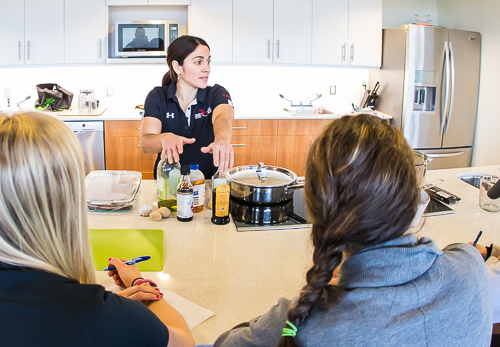
Many of the Canadian Sport Institute Calgary’s (CSIC) specialists have had the privilege of being recognized as national leaders within their respective fields. This list includes Registered Dietitian Kelly Drager, who recently spent time in Montreal sharing her research findings with other sports experts from around the country.
Drager presented in Montreal after being asked by Own the Podium to facilitate two different sessions at the Montreal Sport Innovation (SPIN) Summit 2014. The Montreal symposium was the 9th annual conference put on by Own the Podium, whose conferences have the goal of “developing and networking in the areas of applied sport science, sport medicine, and sport innovation.”
Drager was enthusiastic about the opportunity to share her knowledge at the conference, believing that “SPIN is a great opportunity to connect in person with colleagues and other sport science disciplines. The collaborative candid conversations are often what initiates the creative thinking process, leading to future projects that will further the development of athletes to the highest level possible.”
One of the topics that Drager shared her knowledge about was the concept of Relative Energy Deficiency for Sport (RED-S). RED-S is a syndrome that refers to impaired physiological function including metabolic rate, menstrual function, bone health, immunity, protein synthesis, and cardiovascular health. Along with the interdisciplinary panel of fellow specialists Shaunna Taylor, Trent Stellingwerff, and Adrienne Leslie-Toogood, Drager presented on RED-S and its implications for all coaches and Integrated Support Team members (IST). The group also introduced implications and strategies for paramedical staff, sport scientists, coaches and sport leaders who are looking to improve performance while maintaining athlete health.
The second facilitation Drager was asked to lead was titled Weight Management Consideration for Athletes. Drager’s main goal for the session was to facilitate discussion for determining appropriate weight and body composition for athletes. This is a key consideration for IST members, as often managing weight is necessary for performance and body composition demands are extremely sport specific. Drager addressed issues such as how weight and body composition targets are determined for athletes, key components that should be considered when assessing if an athlete is at an appropriate weight, and what the best approaches to achieve desired changes for an athlete are.
Drager’s work at the CSIC has provided her with the incredible opportunity to further her professional development while working with teams such as the National Wrestling Team and Bobsleigh Skeleton Canada. At the SPIN conference, she was able to share knowledge gained through her work with CSIC teams during one of her workshops by presenting a case study on the consequences of health and performance which reviewed current evidence based approaches to effectively facilitate fat loss while maintaining or gaining lean tissue in the athletic population. The combination of being able to elevate athletes’ performances while also making progress within the ever-evolving field of nutrition is a benefit that Drager knows is enabled by the leaders of the CSIC who are always striving to be a step ahead of the international competition.
Drager recognizes that the environment created at the CSIC has helped her, along with other IST members, stay ahead of the curve when it comes to research. She acknowledges that, “At CSIC we have the ability to directly interact with the athletes on a daily basis as well as the other sport science members of the IST. Seeing the athletes train maximally everyday is motivating, creates a sense of national pride and definitely encourages everyone working within the team to do the best to foster excellence.”
Stay in the loop!
Canadian Sport Institute Calgary: @csicalgary
Written by Brittany Schussler: @bschussler
Photo by Dave Holland: @csicalgaryphoto
Dec 1, 2014
Tentative Aquatic Schedule for December 5-7, 2014
Here is the link to our tentative aquatics schedule for Friday, December 5 to Sunday, December 7 2014:
https://drive.google.com/file/d/0B_i06kI_D5XWX3N4ZnFieEVRQUU/view?usp=sharing
https://drive.google.com/file/d/0B_i06kI_D5XWX3N4ZnFieEVRQUU/view?usp=sharing
Subscribe to:
Posts (Atom)